
Oil Tank Replacement Cost in New Hampshire: What Homeowners Should Expect
How much does it cost to replace an oil tank in New Hampshire?
The oil tank replacement cost in New Hampshire depends on your existing tank's condition, the size and type of the new tank, installation access, and whether old tank removal is included. Replacing a residential heating oil tank is more than purchasing new equipment. The total project may also include labor, fuel handling, piping modifications, disposal, and applicable permits.
At New Hampshire Oil Tank Replacement, we help homeowners understand the factors that affect heating oil tank replacement and plan their next steps.
Whether your tank is in a basement, garage, or outdoor location, this guide explains what contributes to the final replacement price, how to compare estimates, and what to consider before selecting a new heating oil tank.
Planning to replace your heating oil tank?
Call
603-931-4404 or
request a free oil tank replacement estimate.
Cost To Replace Oil Tank Concord NH
How Much Does It Cost to Replace an Oil Tank in New Hampshire?
There is no single price that applies to every oil tank replacement project in New Hampshire.
The total cost of replacing a residential heating oil tank depends on the equipment selected and the amount of work required to remove the existing system and install the replacement safely.
For example, replacing an accessible above-ground steel tank may involve less labor than removing an aging basement tank through a narrow staircase. A project involving a double-wall tank, new piping, or relocation may require additional materials and installation work.
What Is Included in an Oil Tank Replacement Estimate?
A complete estimate may include the following:
| Cost component | What it covers |
|---|---|
| New heating oil tank | The selected tank, size, model, and construction |
| Installation labor | Positioning, securing, connecting, and testing the new tank |
| Old tank removal | Preparing, disconnecting, and removing the existing tank |
| Fuel handling | Managing remaining heating oil, when necessary |
| Piping and fittings | Replacement or adjustment of compatible fuel, fill, and vent connections |
| Tank supports | Suitable legs, bases, or other manufacturer-required support |
| Disposal | Transportation and appropriate disposal of the old tank |
| Permits and inspections | Applicable local approvals and inspection requirements |
| Additional work | Changes required because of access limitations, damage, or site conditions |
Not every project requires every item listed above.
Before accepting a quote, ask whether removal, disposal, fuel handling, and installation materials are included in the total price.
The most reliable way to establish your actual replacement budget is to obtain a property-specific estimate.
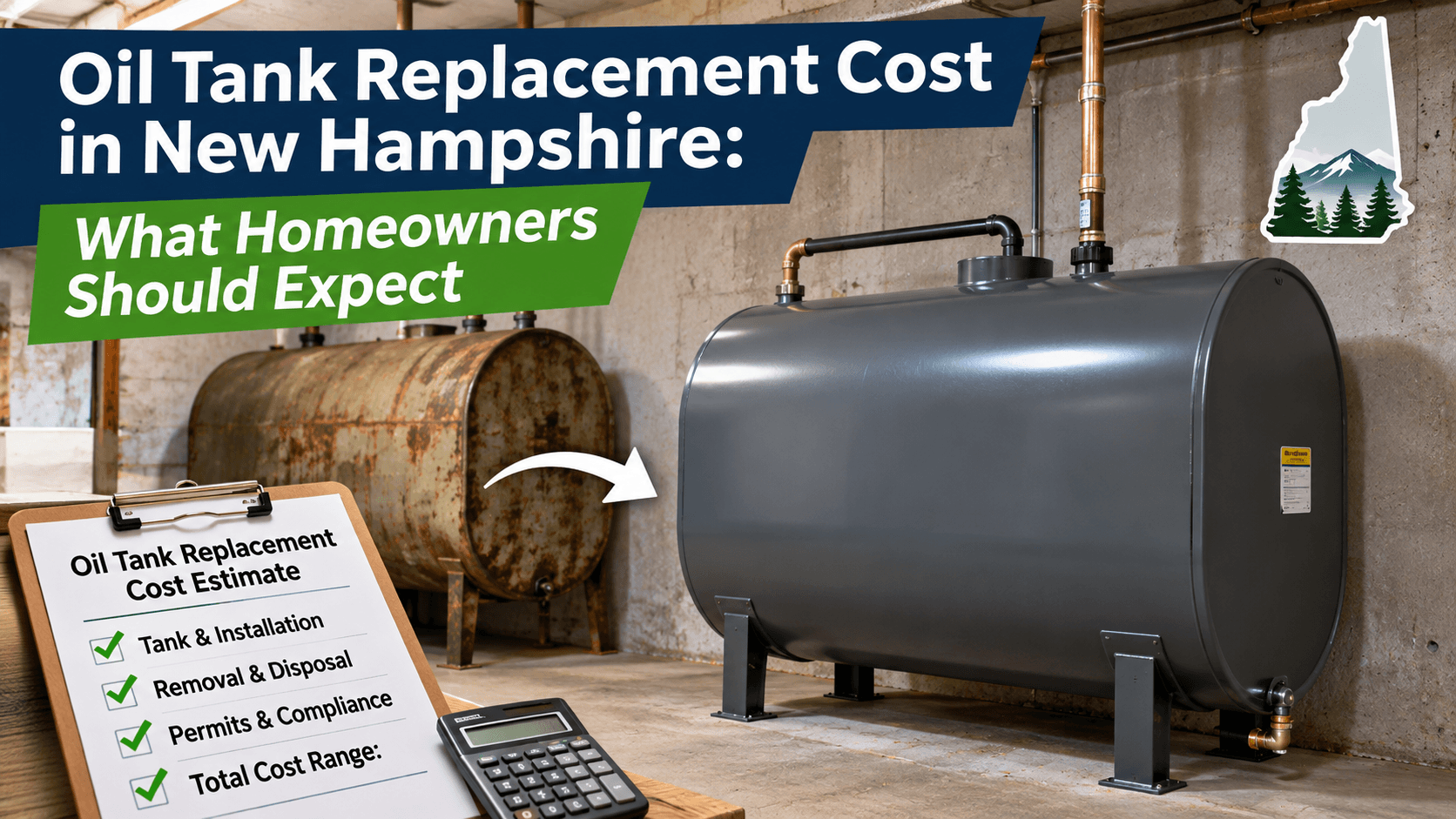
7 Factors That Affect Oil Tank Replacement Costs in NH
Understanding what influences replacement costs can help you compare proposals and avoid unexpected charges.
1. Heating Oil Tank Size
Tank capacity affects equipment selection, dimensions, and installation requirements.
Common residential heating oil tanks include 275-gallon and 330-gallon configurations, although other sizes may be suitable depending on the property.
A larger tank may have a higher equipment cost and may require additional handling during installation.
However, the correct capacity should be based on your home's heating needs, available installation space, and the manufacturer's specifications—not purchase price alone.
2. Single-Wall vs. Double-Wall Tank Construction
The design of your replacement tank can influence its cost.
Traditional single-wall steel tanks and double-wall systems have different construction features.
Double-wall systems incorporate secondary containment, which can provide additional protection if the primary tank develops a leak.
Both designs require suitable installation and maintenance.
If you are comparing equipment options, ask your installer about the construction, dimensions, compatibility, and warranty of each model.
3. Basement, Garage, or Outdoor Location
The location of your existing tank can significantly affect the work involved.
Basement installations: May require moving the old tank through doorways, staircases, or restricted spaces.
Garage installations: Require suitable placement, protection, and connections based on applicable requirements.
Outdoor installations: May require weather-appropriate equipment, stable supports, and protection from damage.
New Hampshire winters also make proper outdoor placement especially important.
The simplest installation is not necessarily the most suitable one. Tank location should be assessed for safety, accessibility, and long-term maintenance.
4. Old Tank Removal and Disposal
When replacing an existing tank, removal is an important part of the project.
The contractor may need to disconnect the tank, manage remaining fuel, prepare it for removal, transport it, and arrange appropriate disposal.
A tank in a difficult-to-access area may require additional preparation and labor.
For a more detailed explanation of removal-specific expenses, read our guide to oil tank removal costs in Concord, NH.
5. Fuel Lines, Pipes, and Connections
Installing a new tank may require more than connecting it to the existing fuel line.
The contractor should assess relevant components, including:
- Fill and vent pipes
- Fuel supply lines
- Valves and fittings
- Tank gauges
- Supports and connections
Some existing components may remain suitable, while others may need replacement or modification.
Ask which materials are included in the proposed installation and which would be charged separately.
6. Accessibility and Installation Labor
Labor requirements vary depending on the installation environment.
A replacement project may become more complex when the existing tank is located behind permanent fixtures, near restricted entrances, or in a basement with limited working space.
Before obtaining a quote, provide details about the tank's location, the access route, and any visible damage.
Photographs may help the contractor understand the installation conditions before an on-site assessment.
7. Permits, Inspections, and Site Conditions
Applicable building, fire-safety, and environmental requirements can affect the overall project.
Some installations may require local approvals or inspections, depending on the type of tank, its location, and the work being performed.
Requirements should be confirmed with the relevant local authority and qualified installer.
If an old tank has leaked, additional assessment or environmental work may be necessary. Such work can substantially change the project cost.
275-Gallon Oil Tank Replacement Cost in New Hampshire
A 275-gallon heating oil tank is a common residential configuration, making it a frequent consideration for New Hampshire homeowners planning a replacement.
However, the price of a 275-gallon tank alone is not the same as the full replacement cost.
The total amount depends on whether the project requires:
- A new tank and compatible supports
- Removal and disposal of the existing tank
- Transfer or management of remaining heating oil
- New fuel, fill, or vent piping
- Changes to the installation area
- Additional labor or applicable approvals
When comparing quotes, make sure the proposals cover the same scope of work.
For a closer look at equipment pricing in the Concord area, see our guide to new heating oil tank costs in Concord, NH.
Is a Roth Oil Tank More Expensive Than a Traditional Steel Tank?
Homeowners replacing an older single-wall heating oil tank may consider a Roth double-wall tank system.
The main difference lies in the tank's construction and protective features.
A traditional steel tank and a Roth double-wall system may differ in:
- Equipment purchase cost
- Construction and secondary containment
- Dimensions and installation requirements
- Compatible components
- Manufacturer warranty terms
A Roth system may involve a higher initial equipment expense than some traditional steel tank options, but actual comparisons must be based on the selected models and installed quotes.
The appropriate choice depends on your installation location, budget, available space, and long-term priorities.
Ask for a written comparison that includes the equipment, installation materials, labor, and applicable warranty details.
Basement vs. Outdoor Oil Tank Replacement: Which Costs More?
Homeowners sometimes assume that installing a heating oil tank outdoors is always cheaper than installing one in a basement.
That is not necessarily the case.
A basement tank may require additional labor because of narrow access routes or restricted working space. However, the area may already contain suitable heating oil connections.
An outdoor installation may provide easier physical access but require additional supports, protective measures, piping, or changes to the installation location.
| Consideration | Basement tank | Outdoor tank |
|---|---|---|
| Weather exposure | Generally sheltered | Exposed to local weather conditions |
| Accessibility | Depends on stairs and available space | Depends on exterior access |
| Installation preparation | May involve restricted entry or existing fixtures | May require a suitable base and location |
| Piping requirements | Depends on existing connections | May require changes to connections |
| Main cost concern | Access and labor | Site preparation and protection |
Neither location is automatically the least expensive.
A qualified installer should evaluate the available space, equipment specifications, and applicable requirements before recommending a location.
When Should You Replace an Aging Heating Oil Tank?
Oil tank replacement is not always prompted by an active leak.
Some homeowners schedule replacement after noticing deterioration or receiving advice following a professional inspection.
Possible warning signs include:
- Visible rust or corrosion
- Oil stains or unexplained fuel odors
- Damage around the tank or fittings
- Deteriorated supports
- Evidence of leakage
- Concerns identified during an inspection
Tank age is another consideration, but age alone does not establish whether a tank is safe or needs immediate replacement.
Its condition, construction, installation environment, and maintenance history all matter.
If you suspect an active leak, avoid disturbing the tank or attempting repairs yourself. Contact a qualified professional promptly. Applicable oil spill reporting requirements may also apply.
How to Compare Oil Tank Replacement Quotes
Replacing a heating oil tank is a significant home maintenance decision.
Comparing written estimates can help you understand what you are paying for and identify important differences between proposals.
Before selecting a contractor, ask:
- What tank manufacturer, model, and capacity are included?
- Does the price include removing and disposing of the old tank?
- How will any remaining heating oil be handled?
- Are new piping, fittings, and tank supports included?
- Who is responsible for applicable permits and inspections?
- What additional work might change the quoted price?
- What manufacturer and workmanship warranties apply?
A lower initial quote is not necessarily the better value if important services are excluded.
Focus on the complete scope of work, installation requirements, and the suitability of the proposed replacement.
How to Prepare for an Oil Tank Replacement Estimate
You can help make the estimating process more efficient by gathering basic information about the existing tank.
Useful details include:
- Your New Hampshire town or city
- Approximate tank capacity, if known
- Whether the tank is in a basement, garage, or outdoors
- Available access through doors and stairways
- Visible corrosion, damage, or leakage
- Approximate age, if known
- Whether you are considering a standard steel or double-wall tank
- Any concerns about the installation location
Photographs of the tank and surrounding area may also help with an initial assessment.
Do not disconnect fuel lines, move the tank, or attempt to drain heating oil yourself.
Oil Tank Replacement in Concord and Across New Hampshire
New Hampshire homes vary in age, layout, heating requirements, and installation conditions.
A tank replacement in a Concord basement may involve different access considerations than a project involving an outdoor tank or a home with a restricted utility area.
The contractor should assess the actual installation conditions rather than assume the same approach is appropriate for every property.
At New Hampshire Oil Tank Replacement, we help homeowners explore their heating oil tank replacement options and understand the work involved.
Contact us to discuss service availability in your New Hampshire location and request an estimate for your property.
Frequently Asked Questions About Oil Tank Replacement Costs
How much does a 275-gallon oil tank replacement cost in New Hampshire?
The total cost depends on the tank model, removal requirements, installation location, labor, and necessary connections. The price of a 275-gallon tank alone does not represent the full installed replacement price. Request an itemized estimate based on your existing system.
Does oil tank replacement include removing the old tank?
Not every estimate includes the same services. Ask whether disconnection, remaining fuel handling, removal, transportation, and disposal are included in the quoted amount.
Is it cheaper to replace a basement oil tank or an outdoor tank?
Neither option is automatically cheaper. Basement access, exterior site preparation, required piping, and other installation conditions affect the final price.
Do I need a permit to replace an oil tank in New Hampshire?
Permit and inspection requirements may depend on the municipality, tank type, installation location, and scope of work. Confirm applicable requirements with the local authority and qualified installer.
Can I transfer the heating oil from my old tank to the new one?
In some situations, suitable remaining heating oil may be transferred using appropriate professional equipment and procedures. The fuel's condition and the replacement circumstances must be evaluated first.
Should I replace an oil tank that has rust?
Visible rust should be evaluated by a qualified professional. Surface corrosion and serious structural deterioration are not necessarily the same, but rust can indicate a developing problem that requires attention.
Does homeowners insurance cover oil tank replacement?
Coverage depends on the insurance policy and circumstances. Routine replacement due to aging or wear is generally different from a covered sudden loss. Review your policy and ask your insurer about applicable coverage and exclusions.
How can I get an accurate oil tank replacement estimate?
Provide your tank's approximate capacity, location, condition, and access details. Request a written estimate showing the replacement equipment, labor, removal, disposal, and any additional services that may be required.
Get a Free Oil Tank Replacement Estimate in New Hampshire
If you're planning to replace an aging heating oil tank, understanding the full scope of work is the first step toward making an informed decision.
New Hampshire Oil Tank Replacement can help you explore replacement options and determine what information is needed for an estimate.
Whether you're considering a traditional steel tank, a double-wall system, or replacing a difficult-to-access basement tank, the project should be evaluated based on your property's actual requirements.
Ready to discuss your oil tank replacement?
Request Your Free Oil Tank Replacement Estimate
Discuss your existing tank, replacement options, and the next steps for your New Hampshire property.